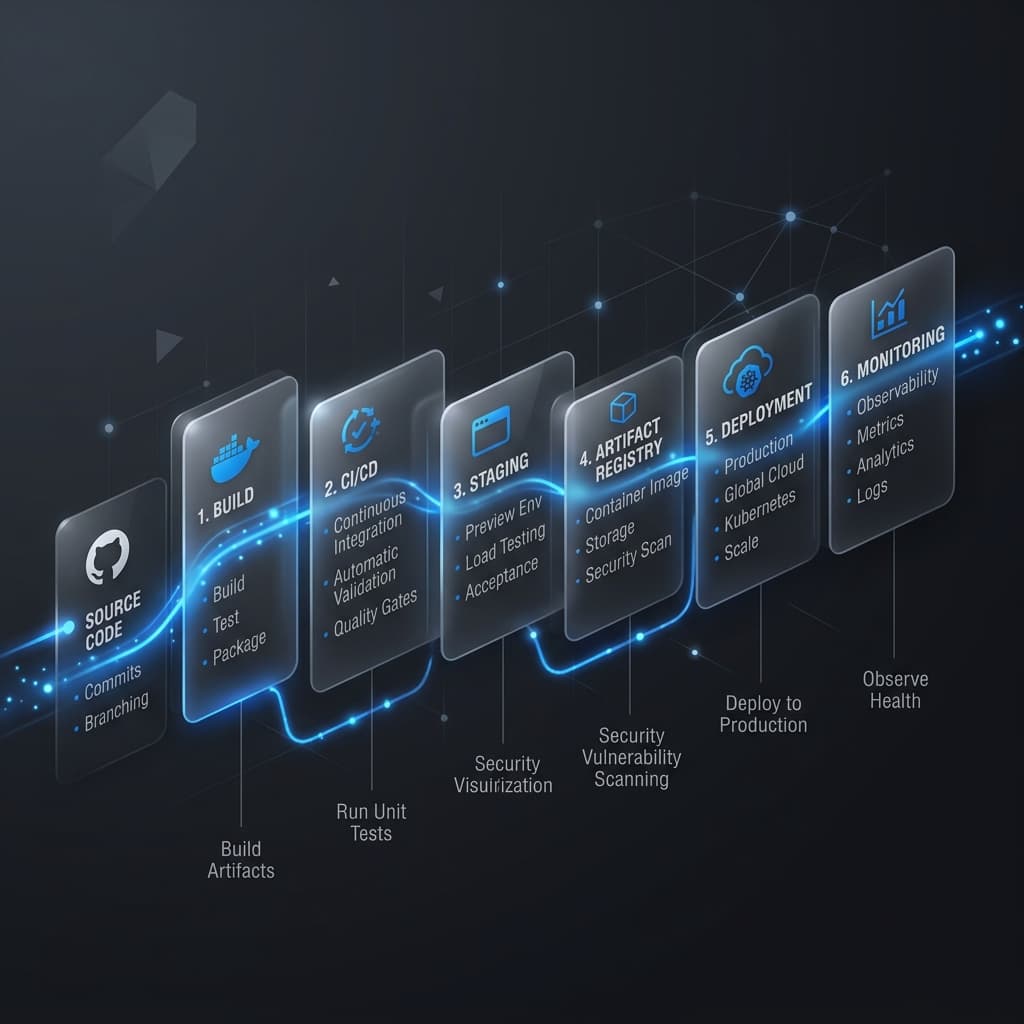
A migration strategy for evolving enterprise APIs safely, with compatibility windows, deprecation policy, and observability checkpoints.
Why API changes fail
In enterprise environments, breaking an API is a critical failure. Many of your clients run legacy systems that cannot be updated quickly. If you roll out a breaking schema change, you disrupt client integrations, resulting in customer support tickets, lost revenue, and damaged commercial relationships. Yet, to ship new capabilities, your API must evolve.
To resolve this, we implement a versioning and deprecation framework. This playbook details how we migrated over 1,200 B2B partners from a legacy XML API to a high-performance REST system without a single minute of downtime.
Versioning policy
We enforce a strict versioning contract that provides clear visibility for downstream clients:
- Additive updates: Field additions and optional query parameters are deployed directly to the active version. Downstream clients must be designed to tolerate extra JSON fields.
- Breaking changes: Any change that alters field types, deletes attributes, or modifies routing requires a new API version (e.g., moving from `/api/v1/` to `/api/v2/`).
- Sunset timeline: Legacy versions are supported for a minimum of 180 days after a new version is released. We return deprecation warnings in the response headers.
- Client tracking: Every API key must be monitored to track version usage. We never retire a version until active client traffic drops below 0.5%.
Compatibility gateway pattern
To simplify backend logic, we avoid writing multiple version handlers in our core services. Instead, we use an API gateway translation layer to map legacy formats to the current internal schema:
Migration runbook steps
When retiring a legacy API version, follow these steps to ensure a smooth transition:
- Publish the migration timeline: Send automated emails to all developers using the legacy version, including documentation links and migration guides.
- Inject deprecation headers: Add HTTP headers (`Deprecation: true`, `Sunset: 2026-12-31`) to all responses served to clients using the deprecated endpoints.
- Monitor query volumes: Create an observability dashboard tracking request rates per client ID and API version.
- Implement brownouts: Prior to final retirement, schedule short, planned service brownouts during off-peak hours. This prompts clients with un-migrated systems to contact support before the official sunset date.
Our take
A successful API migration is 20% code and 80% communication. Do not assume clients will read your documentation or emails. You must track version usage per client ID and proactively contact high-volume partners who fail to migrate. When you design deprecation warnings directly into HTTP headers and build translation layers at the gateway, you isolate legacy code and keep your core services clean.